Published on
May 7, 2026
Why Wealth Management Operations Will Soon Run on Conversation, Not Clicks?
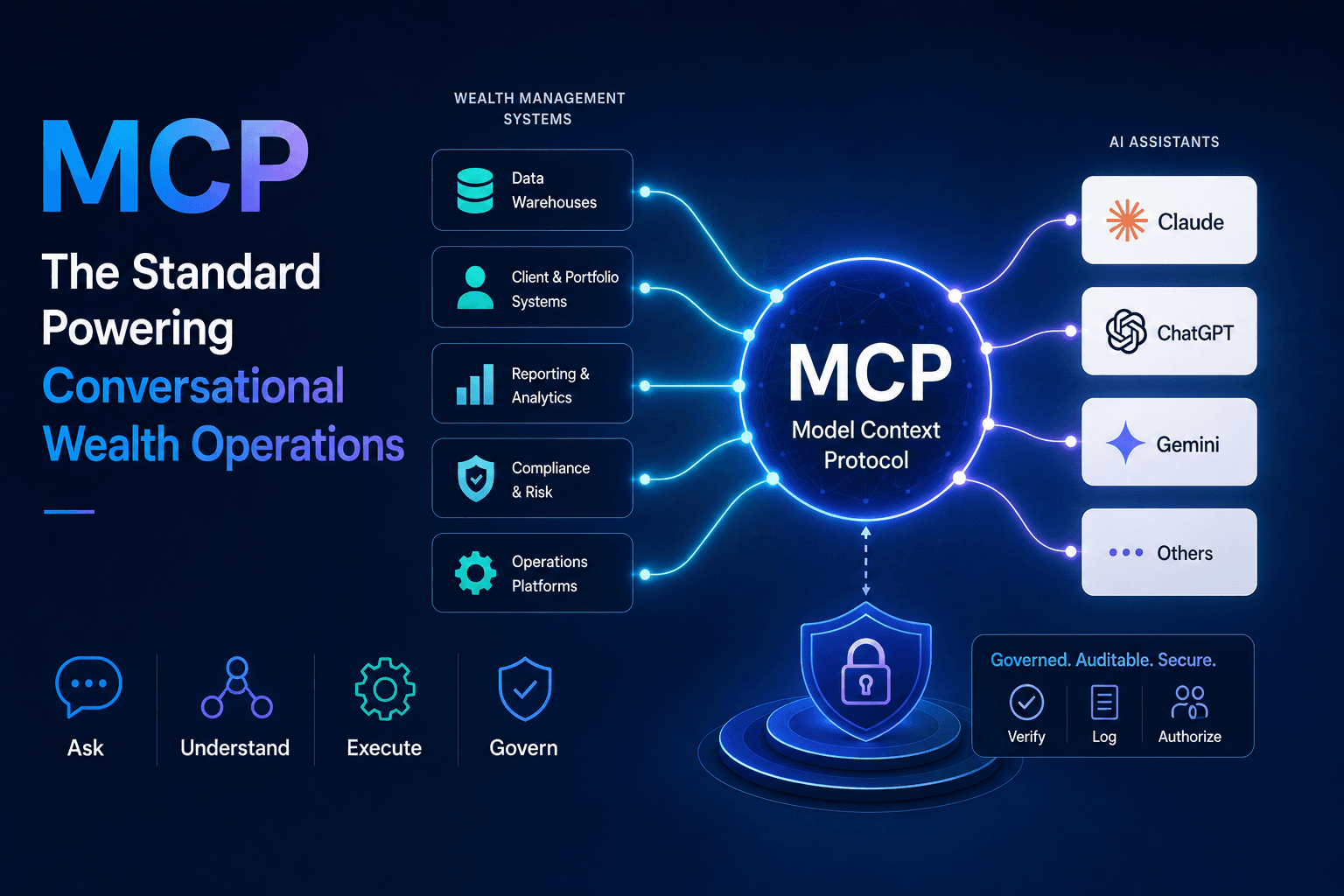
After decades of navigating admin panels, writing SQL queries, and switching between multiple tools to complete basic workflows, wealth management infrastructure is undergoing a fundamental interface shift.
The industry is moving from configuration through clicking to operation through asking.
The Multi-Tool Problem
Here's the reality of most platform operations today:
- You need to validate data, so you open your warehouse.
- Then build a visualization in your BI tool.
- Then configure who can see it in your admin panel.
- Then coordinate deployment with IT.
- Then document the process somewhere else.
Five different contexts. Five different skill sets. One simple outcome that should take minutes, not hours.
From Interfaces to Conversations
The emerging model flips this entirely. Instead of navigating to where functions live in various systems, you describe what outcome you need in plain language. The infrastructure interprets intent and executes across systems.
- Want to understand Q1 performance by strategy? => Ask.
- Need to grant new team members access to specific client portfolios? => Describe the policy.
- Want to track down discrepancies across custodian feeds? => State the question.
The Technical Foundation
What's enabling this shift is the emergence of open integration standards like the Model Context Protocol (MCP)—creating universal connectors between AI models and enterprise systems.
This means any compatible assistant (Claude, ChatGPT, Gemini) can interface with your wealth management infrastructure through a standardized layer.
The result: firms aren't locked into a single AI vendor. As models improve, you can switch providers while maintaining the same operational workflows.
The Governance Question
Here's what will separate successful implementations from disasters:
Natural language interfaces can't become unaudited backdoors into regulated systems. Every request—regardless of how it's phrased—must flow through the same permission checks, API boundaries, and audit trails that govern traditional access.
The conversational layer should be a new front door to existing, controlled infrastructure. Not a side entrance that bypasses governance.
Firms need to ask:
- "Does this AI integration respect our data boundaries?"
- "Can we audit what it does?"
- "Do we control which models access our information?"
- "Can we prove compliance?"
What to Watch For?
As this space evolves rapidly, the key differentiators won't be which AI models platforms support. They'll be:
- How governance is implemented—baked into the foundation or bolted on afterward
- Who controls the infrastructure—whether firms maintain sovereignty over their data environment
- How portable integrations are—whether you're locked to specific AI vendors or can switch as models improve
- What happens when things go wrong—whether there are clear audit trails and rollback capabilities
Looking Forward
We're in the early chapters of this transition. Most wealth management firms are still experimenting with AI-assisted workflows. But the trajectory is unmistakable.
The next generation of operations professionals won't need to memorize where every configuration option lives across six different admin panels. They'll work the way they think—by describing intent and letting infrastructure handle execution.
The only question is whether this shift happens with the governance, transparency, and control that wealth management requires.
Build it right from the start, or rebuild it later under pressure.