Published on
May 13, 2026
Why RIA Record-Keeping Must Follow the Conversation
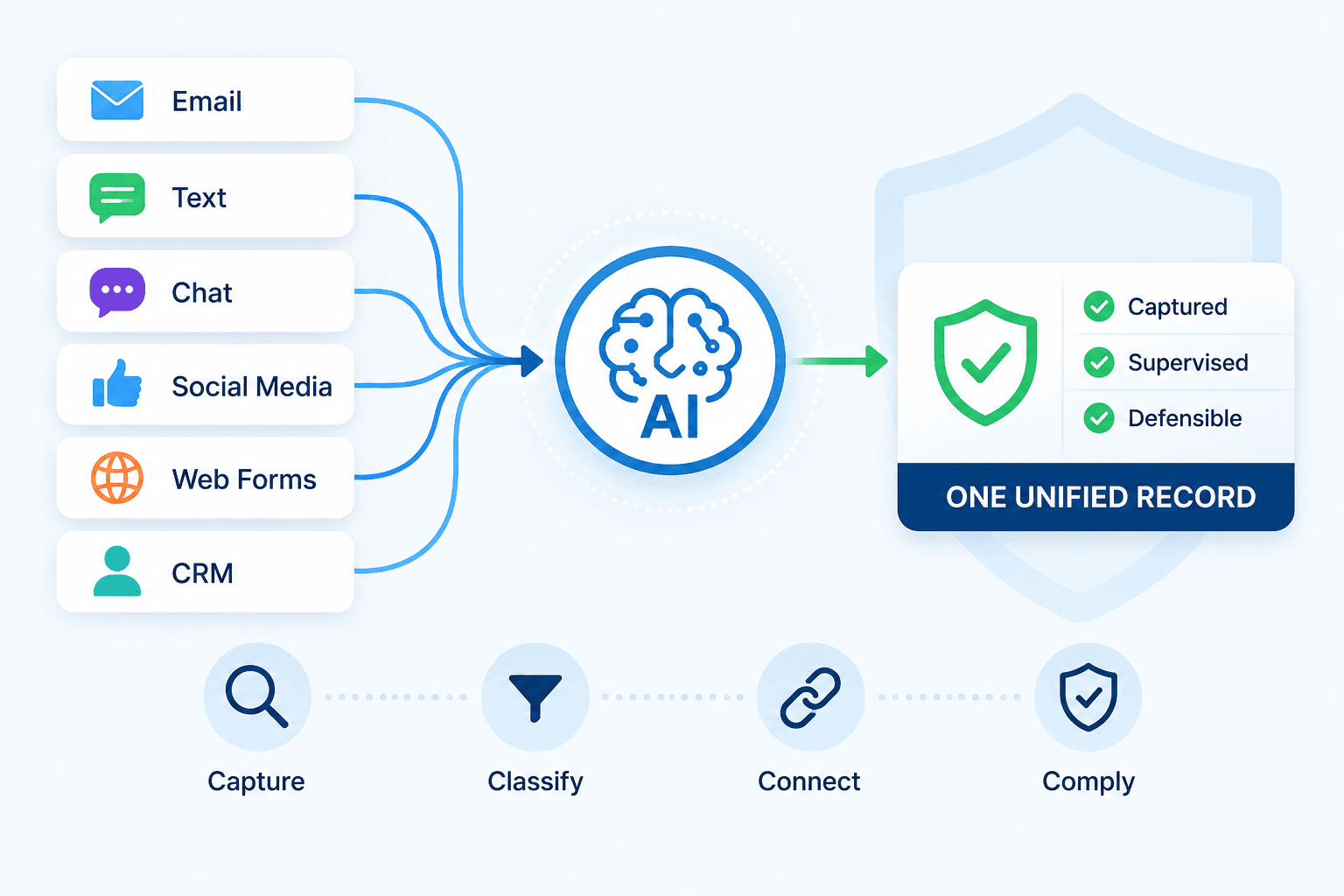
The SEC record-keeping requirements for RIAs and the FINRA record-keeping requirements for business communications are no longer abstract compliance topics.
They are operational realities.
Texts. Emails. Social media. Chat. Web forms. Marketing workflows.
That is where client communication now lives.
And for RIAs, if the communication is business-related, it needs to be retained, supervised, searchable, and defensible.
The Multi-Channel Problem
Most firms still treat communications as separate compliance problems.
Email gets archived in one place.
Texts live somewhere else.
Social posts are reviewed by marketing.
Chat transcripts sit in a collaboration tool.
Web inquiries land in CRM.
Compliance tries to stitch it all together later.
That is not supervision.
That is reconstruction.
And reconstruction is exactly what breaks down during an exam, a complaint, or a policy review.
What The SEC And FINRA Expect
SEC Rule 204-2 requires RIAs to maintain true, accurate, and current books and records relating to their advisory business, including written communications tied to advice, recommendations, transactions, and performance.
FINRA's guidance is equally clear: firms must retain business communications based on the content of the message, not the channel used. If it is business as such, it belongs in the record.
That means the real compliance question is not, "Did we keep the email?"
It is, "Did we capture the full conversation and retain it in a way we can actually defend?"
Why AI Matters
Manual review cannot keep pace with modern communication volume.
AI helps because it can do what human teams cannot do at scale:
- Capture communications across channels.
- Classify what is business-related.
- Link messages to the right client or campaign.
- Flag risky language for review.
- Rebuild fragmented threads into a usable record.
That is why AI is becoming more important in record-keeping.
Not because it replaces compliance.
Because it makes compliance operationally possible.
How It Helps RIAs
For RIAs, the value is practical.
AI can help reduce missed captures from off-channel activity.
It can flag marketing claims, testimonials, and performance language before they become issues.
It can reconstruct multi-channel interactions into one auditable timeline.
It can surface exceptions early, instead of after an exam request arrives.
That is how policy adoption improves.
When the right behavior is embedded into the workflow, compliance becomes part of the way people work — not something they remember after the fact.
The Governance Point
AI only works if it stays inside a controlled framework.
Every captured message, summary, tag, and alert must be traceable back to the original record. Every action must sit inside permissions, retention rules, and audit trails.
For RIAs, that is the real standard.
Not whether the system is smart.
Whether it makes supervision more complete, more consistent, and more defensible.
The Direction The Industry Is Moving
The firms that get this right will not be the ones with the most tools.
They will be the ones that unify communication oversight across every channel and make compliance part of the operating model.
That is where AI has real value.
Not as a shortcut.
As a control layer that helps RIAs keep pace with how business actually gets done.