Published on
September 16, 2026
Fee-Only Advice Has a Productivity Problem
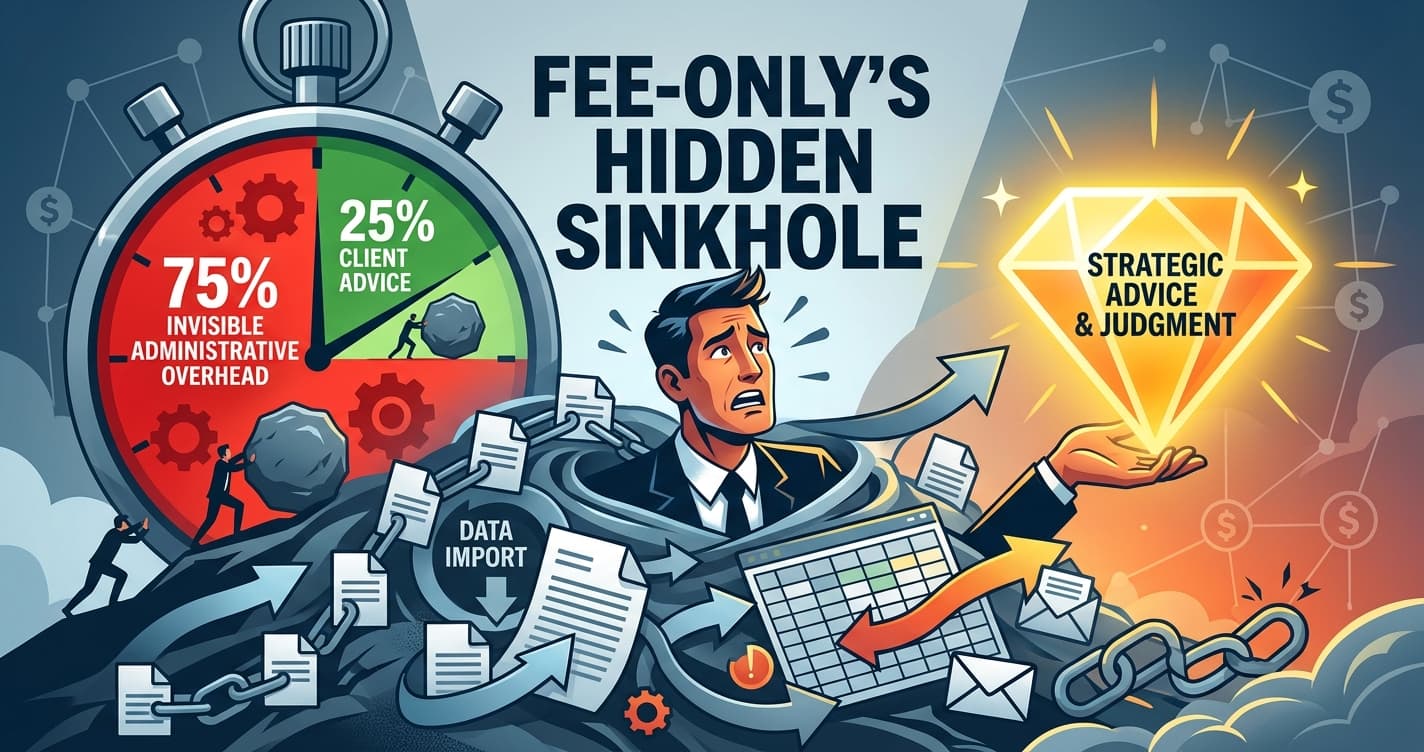
A fee-only advisor may charge around $300 per hour.
That sounds attractive.
But the headline rate is only part of the story.
For every hour spent delivering advice, the advisor may spend almost two additional hours on work that is necessary, but not directly billable. Recent Kitces research highlights this hidden workload and the challenge it creates for advice-led business models.
The simple economics
Imagine the advisor spends:
One billable hour
- Speaking with the client.
- Providing advice.
- Discussing planning decisions.
- Explaining recommendations.
Revenue: $300
Two supporting hours
- Collecting information.
- Reconciling data.
- Entering information into multiple systems.
- Preparing reports.
- Drafting emails.
- Chasing documents.
- Updating CRM records.
- Preparing meeting materials.
- Dealing with paperwork and administration.
Additional direct revenue: $0
The result:
- Three hours of work.
- One billable hour.
- $300 of revenue.
- An effective revenue rate of approximately $100 per hour before overhead.
That is the hidden time problem.
The issue is not that fee-only advice lacks value
Financial planning is valuable.
The problem is that a significant amount of work is required to deliver that advice, but not all of that work is easy to price or bill separately.
This distinction matters:
- Clients value clarity, judgment, responsiveness, and confidence.
- They do not necessarily want to pay separately for every data import, spreadsheet update, email, document request, or system entry.
- Yet those activities still consume the advisor's time.
- The advisor absorbs the cost through lower margins, higher fees, limited capacity, or longer working hours.
An advisor may therefore be highly productive from the client's perspective while operating an inefficient business model behind the scenes.
Why the comparison with AUM is important
An advisor managing a client portfolio of $2 million at a 1% fee generates approximately:
$2,000,000 × 1% = $20,000 per year
That revenue is not directly tied to whether the advisor spends 10 hours or 30 hours servicing the client.
The AUM model effectively prices:
- The ongoing relationship.
- Advice and decision support.
- Portfolio management.
- Coordination.
- Monitoring.
- Access and responsiveness.
- The responsibility of managing the overall relationship.
This does not mean the AUM model is automatically better.
It does mean that the advisor is less directly exposed to the number of hours required to deliver the service.
Hourly, project-based, subscription, and flat-fee advisors face a different economic reality:
- More work does not automatically create more revenue.
- More clients can create more operational pressure.
- Complex clients can become less profitable than expected.
- Growth often requires additional staff before revenue catches up.
- The advisor can end up selling time while carrying a large amount of invisible work.
The overlooked opportunity
The answer may not be changing the fee model.
It may be reducing the amount of work required to deliver the advice.
Imagine the same engagement changing from:
- Three hours of total work for $300.
To:
- One hour of advice.
- Twenty minutes of automated or assisted preparation.
- $300 of revenue.
That is not a small improvement.
It changes the economics of the entire firm.
The advisor could potentially:
- Serve more households without lowering service quality.
- Generate more revenue per employee.
- Reduce the need for operational headcount.
- Improve margins without increasing client fees.
- Offer more accessible advice.
- Spend more time on judgment and relationships.
- Create capacity for more complex planning work.
This is where AI and data infrastructure become strategically important.
AI's most practical role in wealth management
The most useful AI application may not be replacing the financial advisor.
It may be removing the invisible work surrounding the advisor.
Examples include:
- Gathering information from client documents.
- Extracting data from tax returns, statements, and reports.
- Reconciling information across systems.
- Identifying missing or inconsistent data.
- Updating CRM and planning platforms.
- Preparing meeting agendas and briefing notes.
- Creating first drafts of reports.
- Summarizing previous interactions.
- Preparing follow-up task lists.
- Monitoring outstanding client requests.
- Moving information between applications.
- Highlighting exceptions for human review.
The advisor still makes the judgment.
The advisor still owns the client relationship.
The advisor still decides what should be recommended.
But the advisor does not need to spend as much time acting as a human integration layer between disconnected systems.
The real bottleneck is often data, not intelligence
A sophisticated language model cannot compensate for unreliable underlying information.
For fee-only firms, the technology challenge is therefore broader than adding a chatbot to the existing stack.
The real opportunity sits closer to the operating foundation:
- Is the data complete?
- Has it been reconciled?
- Can the source be traced?
- Are conflicting values clearly identified?
- Is the information current?
- Can the advisor see what changed?
- Is there an audit trail?
- Can the firm explain how an output was produced?
In wealth management, AI is only as useful as the data and controls around it.
The future may belong less to the firms with the most impressive AI demo and more to the firms that can reliably turn fragmented client information into usable, accountable insight.
What this means for fee-only firms
Fee-only firms should not ask only:
"Can this technology generate a financial plan?"
They should also ask:
- How much preparation time does it remove?
- How many systems does it connect?
- How much manual rekeying does it eliminate?
- Can it identify missing or contradictory information?
- Does it reduce administrative work without weakening controls?
- Can an employee review and correct its output easily?
- Does it create a traceable record of the information used?
- Can the firm measure the time saved per client?
- Does it improve capacity without compromising the client experience?
The best business case may not be a dramatic reduction in headcount.
It may be the ability to grow without adding operational complexity at the same rate.
A warning for technology vendors
There is also a lesson for WealthTech providers.
A "financial planning copilot" that produces attractive text is not necessarily solving the advisor's most expensive problem.
The higher-value questions are:
- Can the product connect to the firm's existing data sources?
- Can it reconcile information before generating an answer?
- Can it distinguish facts from assumptions?
- Can it show the origin of each important data point?
- Can it handle exceptions rather than simply produce a confident response?
- Can it fit into the firm's actual workflow?
- Can it reduce the administrative burden surrounding advice?
The value is not in generating more content. The value is in reducing the amount of low-value work required to produce a trustworthy outcome.
The broader strategic point
Fee-only advisors are not necessarily doing less work than AUM advisors.
They may simply be receiving less revenue for each hour of total work performed.
That is why productivity and workflow design matter so much.
If technology removes the invisible work around advice, the impact could be significant:
- Advice-only models become easier to scale.
- Flat-fee models become more economically viable.
- Subscription models become more attractive.
- Smaller firms can compete with larger platforms.
- Clients may gain access to more affordable advice.
- Advisors can spend more time on judgment, empathy, and relationships.
The goal is not to automate the relationship.
The goal is to make the relationship economically sustainable.
The takeaway
The future of fee-only advice may not depend on charging more for every hour.
It may depend on needing fewer hours to deliver the same high-quality advice.
That is the real promise of AI and better data infrastructure in wealth management:
Not replacing the advisor, but removing the invisible work that prevents the advisor from scaling.
In the end, clients pay for insight, judgment, and confidence.
The opportunity is to stop spending so much of the advisor's time on everything that happens before the insight can be delivered.