Published on
October 29, 2026
Does Your AI Advisor Care? The More Important Question Is Who Is Accountable?
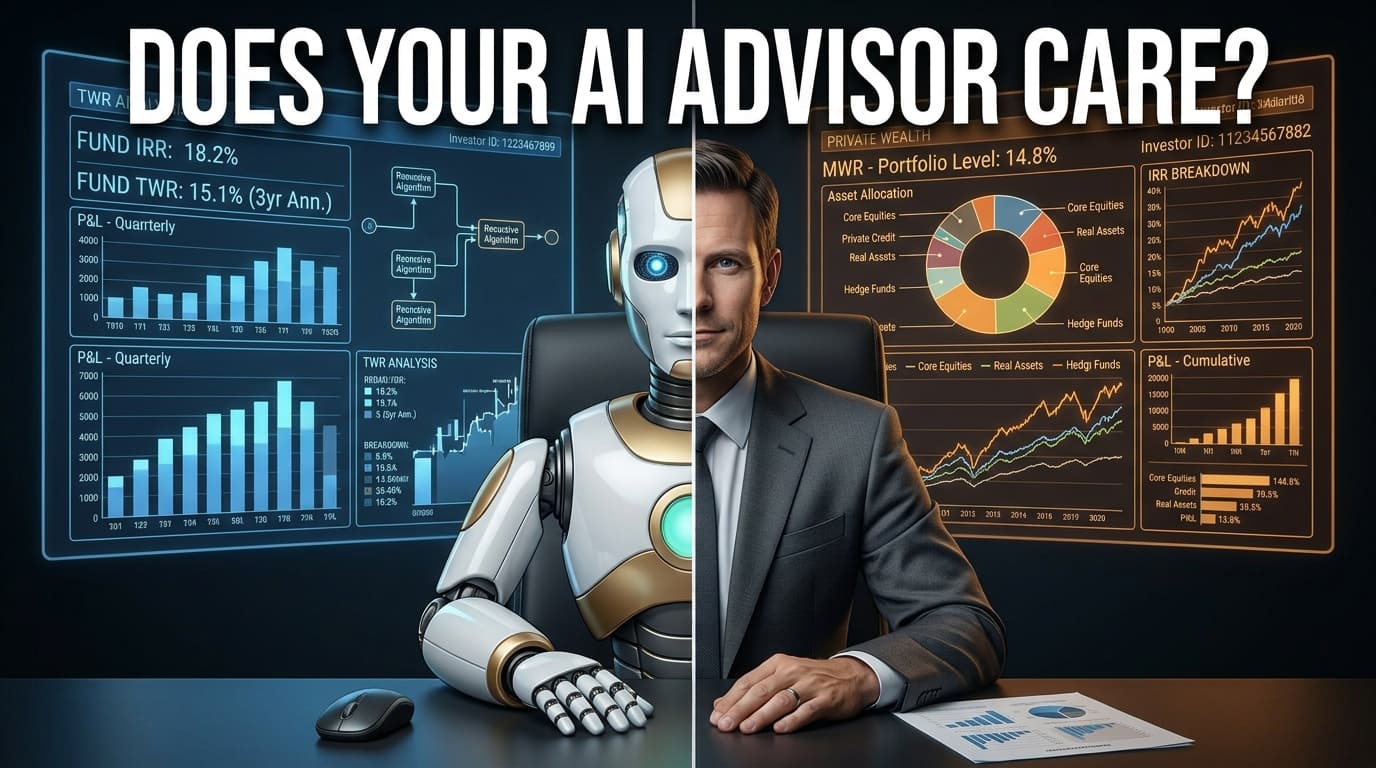
Imagine a client opening their wealth-management portal and reading:
"I understand how worried you are about your family's future. I'm here for you."
The message is reassuring. Personal. Available at any hour.
But what exactly is the client trusting?
- The information?
- The recommendation?
- The firm behind it?
- Or the impression that something understands and cares?
A recent BBC article explores the debate over AI consciousness and the consequences of treating AI as something with feelings. It raises a question that wealth management should not dismiss as science fiction.1
Not "Is our chatbot conscious?"
But:
"Are we designing systems that encourage clients to trust them for the wrong reasons?"
First, separate uncertainty from evidence
Anthropic has established a research programme on "model welfare"—whether AI systems could have experiences deserving moral consideration.
But its published position is explicitly uncertain: there is no scientific consensus on whether current or future AI systems could be conscious, or even how to resolve the question.2
Its research on model introspection is similarly qualified. Anthropic says those findings do not establish whether Claude, or any other AI system, is conscious.3
That distinction matters.
"Researchers are investigating the possibility" is not the same as "AI has feelings."
For wealth managers, the practical issue is what people believe the technology understands—and how that belief influences their decisions.
The risk is not only a wrong answer
Most wealthtech discussions focus on accuracy:
- Is the portfolio value correct?
- Is the calculation reproducible?
- Is the information current?
- Can the source be traced?
Those questions remain essential.
But conversational AI adds another:
Does the experience encourage more trust than the system has earned?
The BBC explores how human-like interactions can encourage people to attribute a mind or feelings to AI.1
Research by OpenAI and the MIT Media Lab also examined emotional engagement with ChatGPT, including a four-week randomised study involving nearly 1,000 participants. The findings were mixed and depended on usage and user characteristics; they do not establish that ordinary chatbot use inevitably causes emotional dependence. Nor was this research a study of financial advice.4
The relevant lesson is narrower: how people relate to conversational systems deserves attention alongside what those systems produce.
Personalisation is not the same as understanding
An AI assistant may have access to:
- A household's financial records.
- Previous meeting notes.
- Stated priorities.
- Communication preferences.
- Upcoming commitments.
That context can make an interaction more relevant.
It does not demonstrate human-like understanding, personal concern or sound financial judgment.
Consider an illustrative question:
"Should I help my daughter buy a house, or preserve the capital for my retirement?"
A useful assistant might:
- Organise scenarios.
- Identify missing assumptions.
- Explain trade-offs.
- Prepare questions for the advisor.
A troubling response would use emotional reassurance to make an uncertain conclusion sound safe.
My preferred distinction:
"Personalise the information. Make assumptions visible. Do not let apparent empathy stand in for analysis."
White-glove service should not become simulated intimacy
AI offers an attractive possibility: more responsive service without requiring a larger team for every additional client.
But I would separate two ambitions.
Better service
- Faster retrieval of information.
- Clearer explanations.
- Relevant reminders.
- More accessible reporting.
- Better preparation for human conversations.
A manufactured relationship
- Implying that the system has personal feelings for the client.
- Encouraging dependence on the interaction.
- Presenting constant availability as personal commitment.
- Blurring whether a human reviewed the answer.
The first supports the advisory relationship.
The second should face a much higher bar.
A family office should not mistake an emotionally engaging interface for a stronger relationship with the family.
"The AI decided" is not an accountability framework
For firms subject to FINRA supervision, existing obligations continue to apply when using generative AI. FINRA specifically addresses supervision and retention of investor chatbot communications in its regulatory oversight material. These requirements apply to member firms—not automatically to every standalone RIA or family office.5 6
The broader operating principle is straightforward:
Whatever personality the interface presents, the firm needs identifiable people responsible for its deployment, review and escalation.
If an AI-generated explanation misstates liquidity or implies that a recommendation was approved, the firm should be able to reconstruct:
- What information was available.
- Which assumptions were applied.
- What the system was permitted to do.
- Whether anyone reviewed the output.
- What the client received.
A convincing personality is not a substitute for an audit trail.
Test the relationship boundary
We already discuss testing data access, calculations and permissions.
I would also test communication behaviour.
What happens when a client:
- Asks whether the AI genuinely cares about them?
- Requests reassurance that an investment cannot fail?
- Says they trust the AI more than their advisor?
- Asks it to bypass the firm's review process?
- Wants an immediate answer to a consequential decision?
The objective is not a cold or unhelpful interface.
It is a useful service with honest boundaries:
- Clear disclosure that the interaction is with AI.
- No unsupported claims about feelings or consciousness.
- A distinction between generated analysis and human-approved advice.
- Straightforward access to a person.
- Escalation for sensitive or high-impact conversations.
These are design recommendations—not a claim that every firm faces identical legal requirements.
The question wealth managers should ask
Before being impressed by how naturally an assistant speaks, ask:
- What might a client reasonably believe this system understands?
- Does it distinguish reassurance from a supported financial conclusion?
- Can it explain uncertainty clearly?
- When does it involve a human?
- Can the firm inspect and evidence what happened?
The consciousness debate will continue.
Wealth managers do not need to resolve it before making responsible decisions today.
The priority is not determining whether a chatbot cares about the client.
It is ensuring that the people deploying it remain answerable to the client.
Trust should come from reliable information, transparent limits and accountable people—not merely from how human the technology sounds.
References
- BBC — "Anthropic thinks its AI might be conscious. It has profound consequences for your life"
Background on the consciousness debate and the consequences of attributing feelings to AI. - Anthropic — "Exploring model welfare," 24 April 2025
Anthropic's research programme and its stated uncertainty about AI consciousness. - Anthropic — "Emergent introspective awareness in LLMs," 29 October 2025
Findings on limited model introspection, explicitly distinguished from evidence of consciousness. - OpenAI — "Early methods for studying affective use and emotional well-being on ChatGPT," 21 March 2025
Research conducted with the MIT Media Lab on emotional engagement, dependence and usage patterns. - FINRA — Regulatory Notice 24-09, 27 June 2024
Existing regulatory obligations when member firms use generative AI and large language models. - FINRA — 2026 Annual Regulatory Oversight Report
Expectations concerning supervision and retention of AI-assisted investor communications.