Published on
October 23, 2026
Building an AI Operating System: The Real Path to Hyper-Personalization in Wealth Management
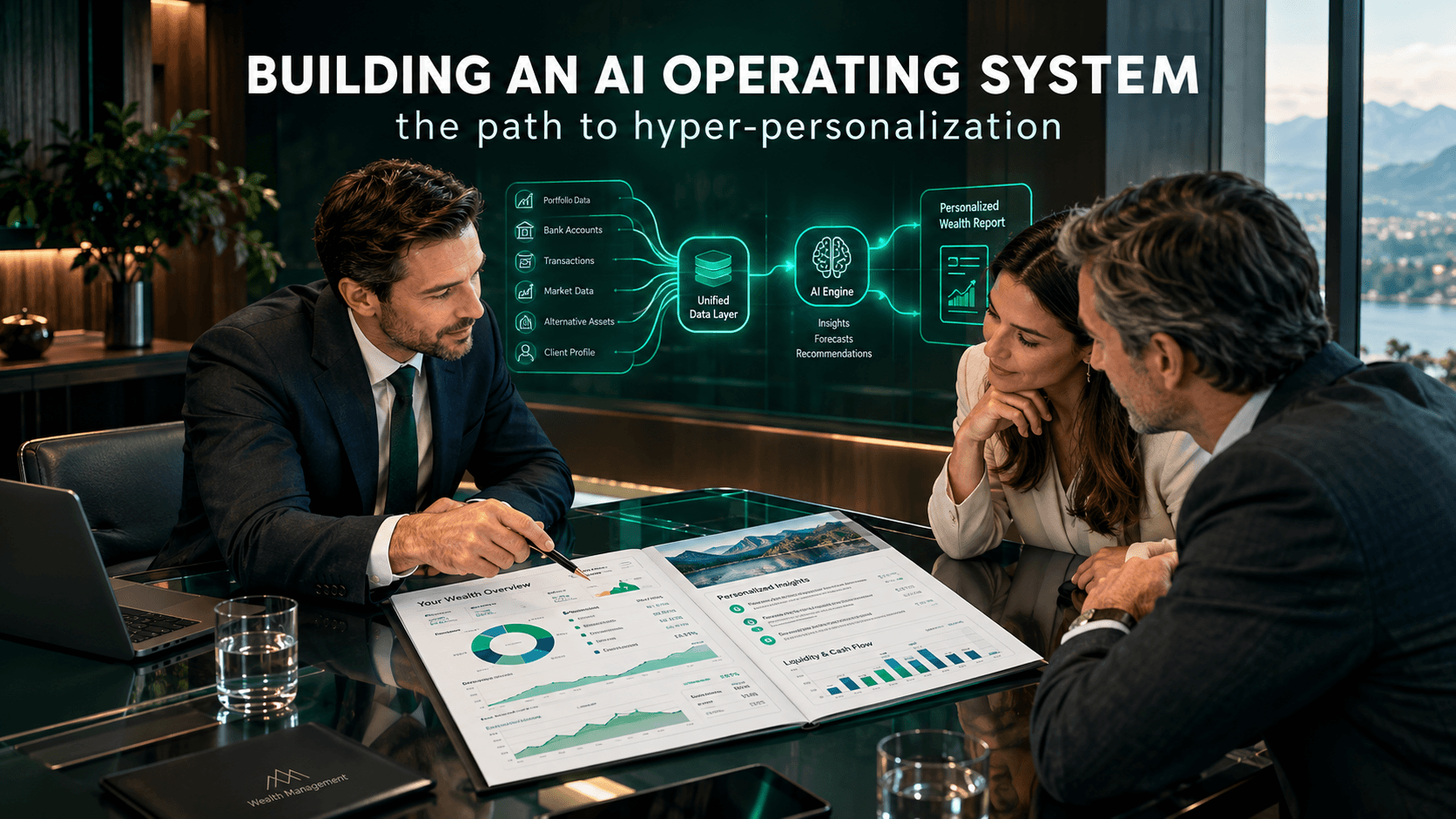
Wealth management has spent years trying to scale advice by standardising the client experience.
AI raises a more interesting possibility:
What if firms could scale without making every client experience look the same?
Not simply a personalised greeting.
A different dashboard. Different priorities. Different alerts. Different meeting preparation.
All grounded in the same governed information.
That is where building an AI operating system becomes interesting—not as another technology purchase, but as a different way of running the practice.
The shift is already happening
Connecticut Wealth Management recently announced a partnership to build an AI operating system across its existing technology environment, initially focused on work surrounding client meetings. The first phase is scheduled for deployment before the end of 2026: an announced implementation, not yet proof of delivered results.1
The significance is broader than one firm.
The discussion is moving from:
- "Which AI tool should we buy?"
To:
- "How should AI work across our business?"
That is a much bigger question.
First, define "AI operating system"
I use the term to mean a coordinated operating layer connecting:
- The firm's data.
- Its business definitions.
- Its analytical tools.
- Its workflows.
- Its permissions.
- Its AI models.
- Its human approval processes.
Not a replacement for Windows. Not necessarily a replacement for the CRM or portfolio platform.
And definitely not just a chatbot with access to more documents.
The purpose is to connect information, analysis and action—without losing accountability.
Hyper-personalization starts before the dashboard
In a September interview, LPL Financial's Nitesh Ambastha described a future in which AI could help deliver highly personalised service to individual investors, potentially making white-glove service less dependent on account size. He presented this as a three-to-five-year outlook, not an established outcome.2
That is the exciting possibility.
But my view is that personalization starts with understanding the client's situation—not generating more content about it.
For a family office or RIA, that means knowing:
- Which entities and accounts belong to the household.
- What the family owns directly and indirectly.
- Which commitments and liquidity needs are approaching.
- What the client has agreed to prioritise.
- Which information each person may see.
- What remains missing, stale or unresolved.
Without that foundation, "hyper-personalization" risks becoming a tailored narrative built on incomplete context.
From asking for a report to asking a question
Imagine an advisor asking:
"Show this household's liquidity against expected commitments over the next 12 months, and flag where valuations are out of date."
An MCP server can expose approved data resources and analytical tools to an AI assistant through the Model Context Protocol. The protocol supports those connections; the underlying services must still provide the calculations and access controls.3
In a well-designed environment, the workflow could:
- Identify the authorised household.
- Retrieve relevant data.
- Run an approved calculation.
- Highlight missing inputs.
- Return a visualisation with sources and dates.
- Prepare follow-up tasks for review.
That is the attraction of on-demand analytics.
But "instant" should describe the interaction—not imply that missing data has appeared, valuations have refreshed or reconciliation has become unnecessary.
One foundation. Different dashboards.
Here is where MCP-enabled analytics can support hyper-personalized reporting.
Consider three illustrative views:
- A principal sees liquidity, commitments and concentrated exposures.
- An advisor sees planning priorities, upcoming decisions and outstanding actions.
- A beneficiary sees only the accounts, documents and information they are authorised to access.
The questions differ. The layouts differ. The permissions differ.
The underlying financial definitions should not.
AI can help configure those views and draft the code behind them. The application still needs review, testing and enforced access controls before release.
Personalise the presentation—not the truth.
An advisor should not get a different exposure figure simply because they phrased the question differently.
MCP is not the only route into the warehouse
An AI operating system should not require everyone to use the same interface.
Different users may need:
- A conversational assistant.
- A client portal.
- A spreadsheet connection.
- A business-intelligence dashboard.
- A scheduled report.
- An API integration.
OData—Open Data Protocol—offers a standard way for applications to query data exposed through a service, including selecting fields, filtering records and retrieving related information. It requires a compatible service; it does not automatically make every warehouse queryable.4
MCP serves a different purpose: connecting AI applications to exposed resources and tools.3
They can coexist.
The architectural goal should be a governed warehouse accessible through appropriate interfaces and plug-ins—not a new dependency on one screen or model.
Personalised service needs consistent execution
There is an important boundary between designing an analysis and repeatedly running it.
AI can help:
- Interpret a new request.
- Configure a dashboard.
- Propose a workflow.
- Draft an explanation.
Approved recurring calculations should run as tested, version-controlled code.
The AI harness—the software surrounding the model—should govern tool use, context and approvals.
The Data Orchestration Layer should coordinate retrieval, validation, exceptions and approved updates.
That is how a personalised experience can sit on a repeatable operating foundation.
Measure client outcomes, not AI activity
In the same interview, Ambastha estimated that 50–60% of advisor and office time goes to non-client-facing work and suggested agentic AI could return substantial time to client activity. Those figures are his stated estimates and expectations—not a universal productivity benchmark.2
For an individual firm, I would measure:
- Preparation time per meeting.
- Unresolved data exceptions.
- Follow-up completion.
- Time from client request to reviewed response.
- Advisor time actually redirected to clients.
More AI-generated reports do not automatically mean better service.
The opportunity is to reduce the effort required to deliver something relevant.
The real operating-system test
Before adopting the label, ask:
- Can different interfaces use the same governed data?
- Do calculations remain consistent across them?
- Are permissions enforced behind every view?
- Can actions and changes be traced?
- Can the firm replace a model or application without rebuilding everything?
If not, "AI operating system" may simply be a new name for another platform.
The ambition should be more substantial:
Hyper-personalization at the experience layer. Consistency at the calculation layer. Accountability at the operating layer.
Because scaling advice should not mean making every client feel standardised.
It should mean making a genuinely relevant experience easier to deliver.