Published on
July 8, 2026
Will AI Push Wealth Management into a Sea of Sameness?
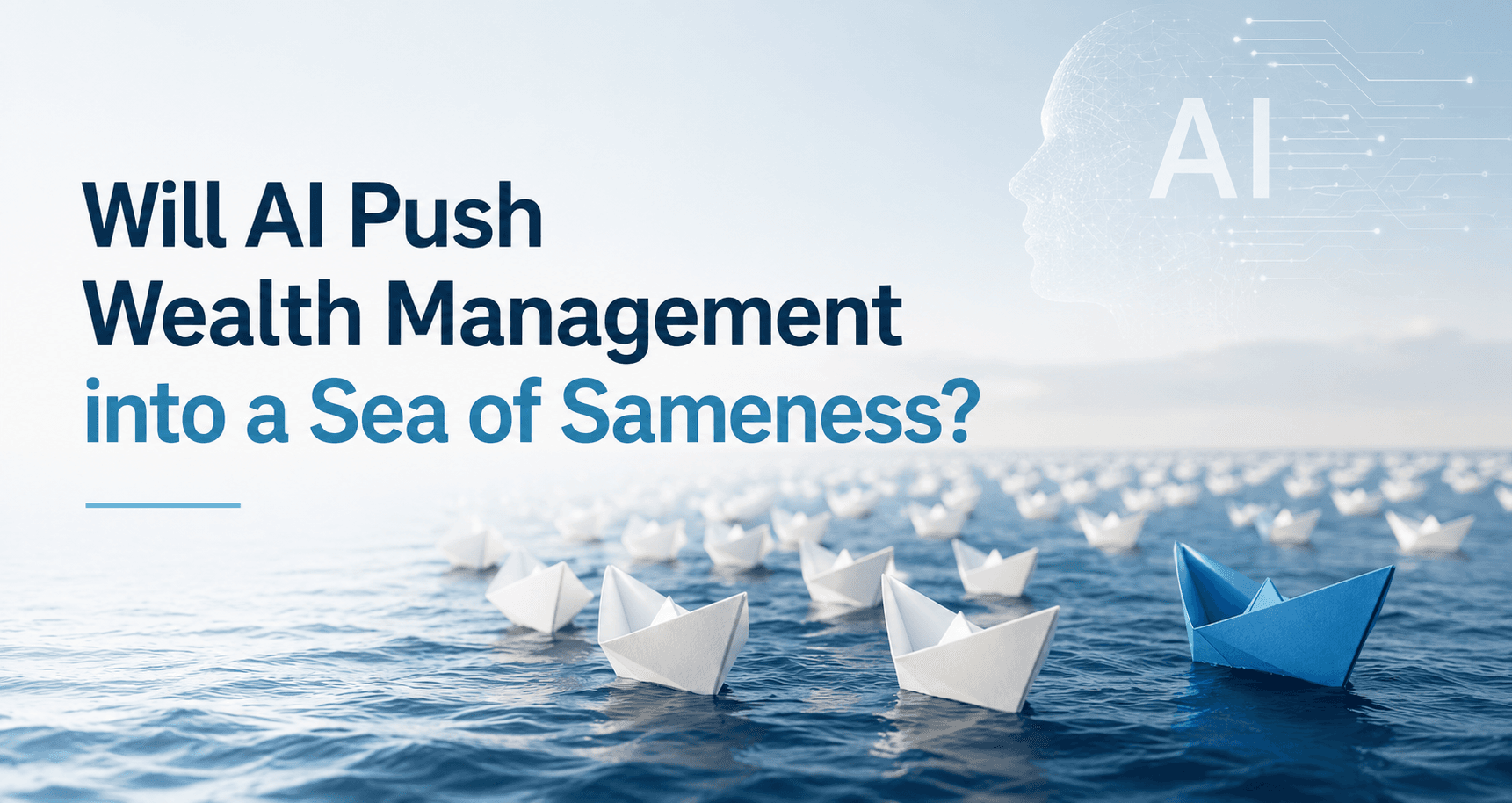
Over the last couple of years, AI has moved from experiment to embedded feature in almost every part of the wealth management stack. It sits inside CRMs, portfolio tools, marketing platforms and even email. Productivity is up. Turnaround times are down. On paper, everyone wins.
But there's a risk we're not talking about enough: when everyone uses the same kinds of AI tools, trained on the same kinds of data, the industry can quietly drift into a sea of sameness.
Instead of amplifying what makes each firm distinctive, AI can flatten it.
How AI Quietly Flattens Differentiation
Most of the widely adopted AI systems are designed to be "generally useful" and "safe." They are trained on massive, overlapping datasets and tuned to avoid extremes. That's sensible from a risk perspective. It also means the default answer from these systems tends to be the middle of the road.
Now layer on top how we actually deploy them in wealth management:
- Vendors ship recommended prompts and templates for client updates, market commentary, and newsletters.
- Platforms offer "best practice" email sequences and marketing journeys.
- Research tools summarise consensus views for quick digestion.
None of this is bad. The problem is scale. When thousands of firms rely on similar models, similar prompts and similar templates, the language, views and even portfolio structures start to converge.
What Sameness Looks Like in Practice
You can already see early signs of this convergence in three places:
1. Investment views and portfolios
If firms feed similar macro narratives, similar coverage lists and similar risk parameters into AI-assisted research tools, there's a natural drift toward similar asset allocation views. Over time, two "balanced" model portfolios from two different firms can end up looking almost interchangeable.
2. Client communication
AI email assistants and content hubs are now standard add-ons in advisor CRMs. They come with libraries of market updates, birthday messages, and review reminders. If a hundred firms lean on the same libraries, clients will receive messages that feel templated, even if they don't know why. Different logo, same voice.
3. Brand and positioning
Visit ten advisory websites today and you will see remarkably similar value propositions: "trusted," "holistic," "goals-based," "personalised." AI makes it easier to produce more of this language, faster. Unless someone deliberately intervenes, the tools will keep generating familiar phrasing because that's what they've learned is "normal."
Why Sameness Is Risky for Advisory Businesses
Sameness feels safe. It avoids controversial statements. It leans on consensus. But it carries three real risks for advisory businesses:
- Commoditisation. If advice, portfolios and communications feel indistinguishable, clients default to comparing fees rather than value. That is a race to the bottom.
- Weak client loyalty. Clients who cannot clearly explain why they chose your firm over another are easier to poach when the next glossy pitch arrives.
- Human talent erosion. Advisors who feel their judgement is being replaced by generic, AI-generated outputs may disengage or leave. The human edge gets dulled.
In a world where "good enough" content and "good enough" proposals can be generated in seconds, leaning into sameness is the riskiest strategy of all.
Using AI to Amplify, Not Erase, Your Difference
The answer is not to reject AI. The answer is to be intentional about how you use it.
Here are five practical ways firms can make AI a differentiation engine rather than a homogenisation engine:
1. Codify your firm's point of view before you automate it
Document your real investment beliefs, planning philosophy, and communication style in structured form: playbooks, narratives, tone-of-voice guides. Feed that into your AI tools. If the system doesn't know what makes you different, it can't protect it.
2. Prioritise your own data over generic narratives
Use AI on your proprietary data: your client behaviours, historical decisions, outcomes, engagement patterns. Ask it to surface the patterns that are unique to your practice. This is where you can find differentiated insights, not just repackaged consensus.
3. Make "human challenge" a formal step in the workflow
Treat every AI-generated output as a first draft. Build a habit (and a process) where advisors are expected to ask: "What is missing here? Where would we disagree? How would I explain this to this specific client?" That tension between the model and the human keeps the advice sharp.
4. Design for variation, not one-size-fits-all templates
Instead of one global quarterly letter, use AI to produce segment-specific versions: by life stage, by primary goal, by behavioural profile. Then have humans refine them. Use the scale of AI to support genuine personalisation, not to stamp the same message on everyone.
5. Measure distinctiveness as a metric, not just efficiency
Most firms measure AI's impact in terms of time saved or pieces of content produced. Add a different question: "Are we starting to sound like everyone else?" Regularly review your public materials and client communications against competitors. If they blur together, that's a signal to adjust the inputs and the governance.
The Strategic Question for Leadership Teams
Soon, "we use AI" will not be a differentiator in wealth management. It will be basic infrastructure, like having a CRM or a client portal.
The real differentiator will be whether your AI tooling reflects a distinctive philosophy and client experience, or whether it quietly pulls you toward the industry average.
So the strategic question for leadership teams is no longer "Should we adopt AI?" It's:
"How will we ensure AI makes us more distinctive, not less?"
On LinkedIn, in boardrooms, and in client conversations, that is the conversation worth having.
I work with financial institutions on technology integration and data aggregation (including API/SDK solutions at Collation.AI). Happy to connect and discuss your firm's technology strategy.