Published on
November 4, 2026
If Your AI Vendor Disappears, Where Do Your Clients' Secrets Go?
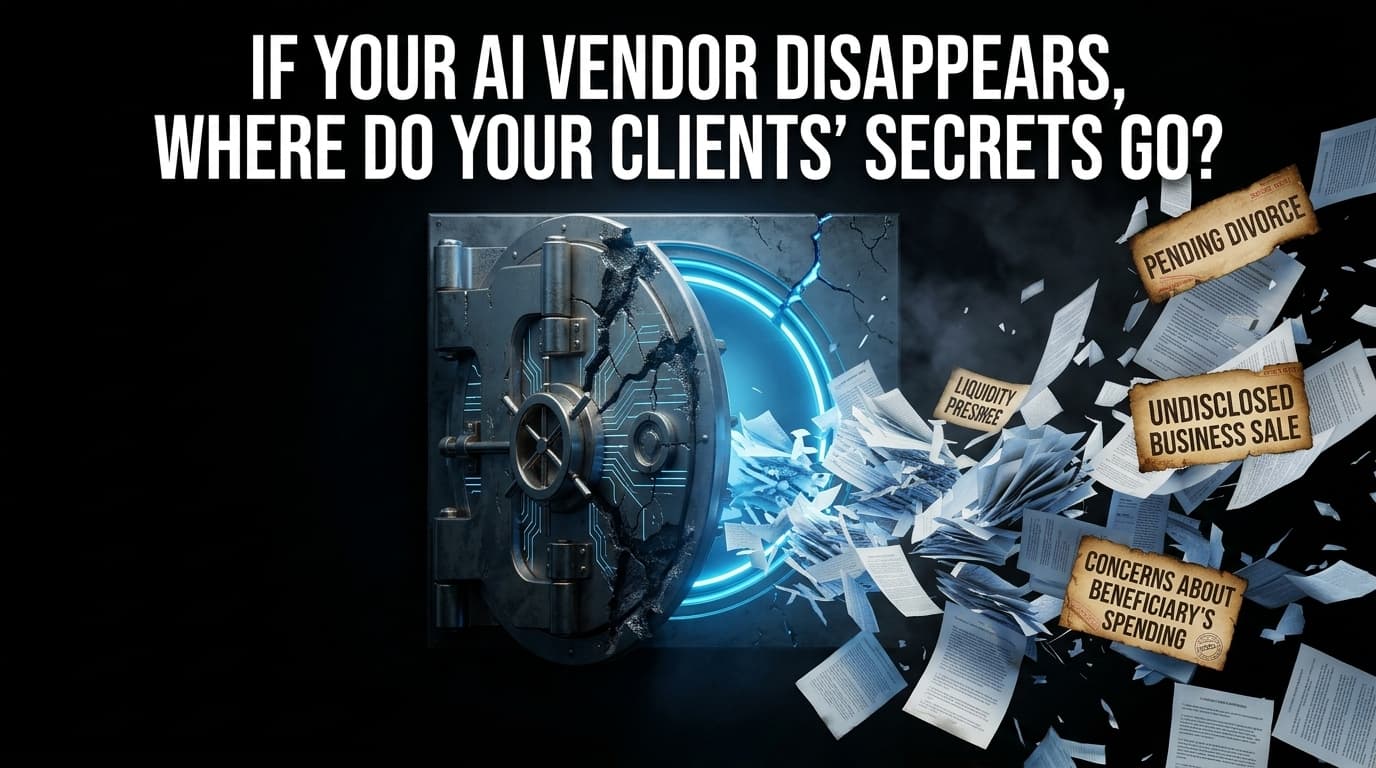
An AI vendor does not need to suffer a cyberattack to become a privacy concern.
It could be acquired.
Change its business model.
Run out of funding.
Or shut down.
That is the uncomfortable question raised by a recent BBC article: what happens to sensitive information when the company holding it can no longer sustain its business? The article explores how data held by AI services could become valuable in a sale or restructuring.1
For wealth managers, registered investment advisors and family offices, this is not simply a consumer-privacy story.
It is a vendor-risk question with unusually personal consequences.
Your AI history may contain more than your CRM
Think about what someone might include in an AI-assisted planning discussion:
- A pending divorce.
- Concerns about a beneficiary's spending.
- A family member's health.
- An undisclosed business sale.
- Disagreements over inheritance.
- Liquidity pressures.
- The reasons behind an unusual investment decision.
These are illustrative examples, but the distinction matters.
A portfolio system records what a family owns.
An AI conversation may reveal why the family is worried—and what it intends to do next.
The BBC makes another important point: people can disclose information about relatives, friends and other individuals who never used the AI service themselves.1
In a family-office setting, that should get our attention.
Privacy risk is also a business-model risk
We usually evaluate AI vendors through familiar questions:
- Is the information encrypted?
- Where is it hosted?
- Who can access it?
- Is it used for training?
- Are security controls independently assessed?
Keep asking those questions.
But add another:
What happens to our information if this company's ownership, finances or strategy changes?
A provider's security posture today does not answer every question about its future.
Nor does a promise not to train models on client data necessarily explain retention, subcontractor access or what happens during a business transfer.
Those are separate issues.
Bankruptcy is not a privacy exemption
It would be wrong to conclude that a struggling company can automatically sell personal information to anyone for any purpose.
Applicable law, contractual restrictions, privacy commitments and court decisions can constrain a transfer.
There is a useful historical example. In its Toysmart settlement, the US Federal Trade Commission sought restrictions on the sale of customer information, including requirements concerning the buyer and continued adherence to the original privacy statement.2
The lesson is not that protections disappear when a vendor fails.
It is that protections need to be understood before failure—not discovered during it.
"We own the data" is only the beginning
Data ownership is important.
But I would ask firms to distinguish ownership from possession, access and control.
A firm may retain contractual ownership while its provider holds:
- Uploaded documents.
- Conversation histories.
- Search indexes.
- Generated summaries.
- Operational logs.
- Backups.
The practical question is not just:
"Who owns the original records?"
It is:
"Who holds every version and derivative we created—and what are they permitted to do with them?"
This is where last week's discussion about vendor lock-in becomes a privacy discussion.
An exit plan should address more than moving reports to another platform.
It should address what remains behind.
Design for less exposure, not just better promises
For RIAs and family offices, I would favour an architecture built around minimisation.
That means:
- Keep authoritative records in an environment the firm controls.
- Give AI access only to the information needed for the task.
- Avoid uploading complete household files when a smaller dataset will do.
- Restrict the tools and data available through the AI harness.
- Limit retention where appropriate and technically supported.
- Keep access revocable and activity traceable.
A client-owned database can support that approach.
It does not, by itself, prove that prompts, logs or documents never leave the environment.
The actual data flows still need to be mapped and checked.
The aim is not "trust no vendor."
It is "avoid creating unnecessary copies of your clients' most sensitive information."
Do not respond by deleting everything
The BBC encourages readers to review sensitive information held by services and use available deletion mechanisms.1
For a regulated firm, that needs an important qualification.
I would not turn a consumer deletion recommendation into a blanket instruction to erase business records.
Instead:
- Identify what is held and where.
- Determine applicable retention requirements.
- Preserve records subject to legal or regulatory obligations.
- Remove unnecessary copies where permitted.
- Ask how deletion applies to backups, indexes and subcontractors.
Deletion should be a governed process—not an emergency reaction.
This belongs in ongoing vendor oversight
For covered US institutions, the SEC's amended Regulation S-P requires written policies and procedures addressing service-provider oversight, including due diligence and monitoring. Its requirements also address incident response and protection against unauthorised access or use of customer information.3
That is not a specific rule prohibiting AI-vendor acquisitions.
But it reinforces a practical point: outsourcing a service does not eliminate the need to oversee how client information is protected.
A successful procurement review should not be the last time anyone examines the relationship.
Five questions before sharing the next client file
- Where will the original data, prompts, outputs, logs and backups be held?
- What happens to each category if the provider is acquired, restructured or closed?
- What contractual restrictions govern transfer and secondary use?
- Can we export required records, revoke access and verify permitted deletion?
- Can we keep operating if this provider becomes unavailable?
These are not anti-AI questions.
They are continuity, confidentiality and fiduciary-business questions.
We do not need to predict whether the AI bubble will burst to prepare for a vendor's failure.
The real test is simpler:
Can we explain to a client what happens to their information—even if the company processing it is no longer the company we chose?
A wealth-management firm should not need its AI vendor to survive forever for its privacy strategy to hold up.
References
- BBC — "The AI bubble could expose your deepest secrets"
- Federal Trade Commission — "FTC Announces Settlement With Bankrupt Website, Toysmart.com, Regarding Alleged Privacy Policy Violations," 21 July 2000
- US Securities and Exchange Commission — Regulation S-P: Privacy of Consumer Financial Information and Safeguarding Customer Information, final rule, 16 May 2024