Published on
May 26, 2026
AI Is Moving Faster Than Compliance — and Financial Services Need to Catch Up
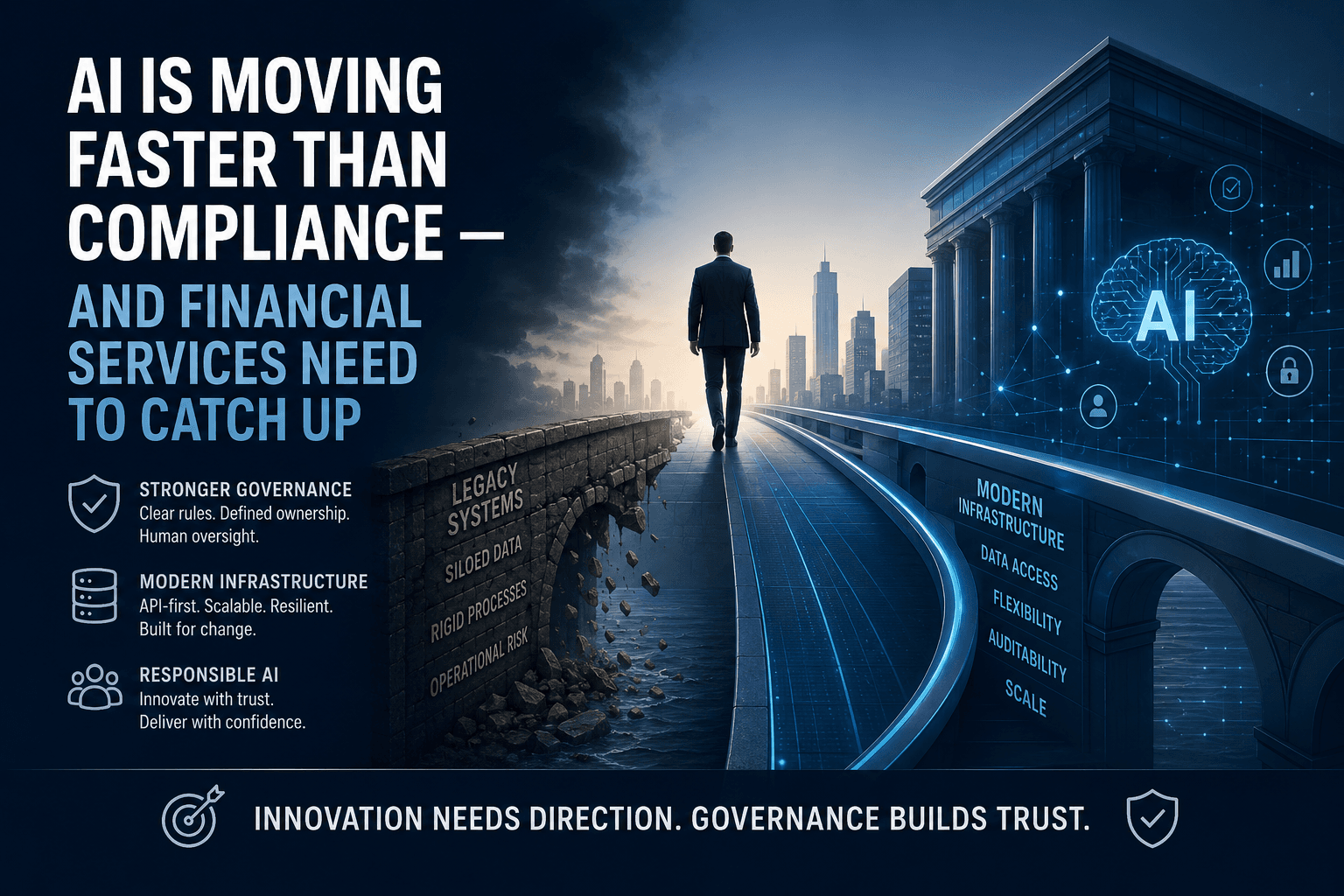
AI is quickly becoming part of the operating model in financial services. But in wealth management and payments, the bigger question is no longer what AI can do. It is whether firms can govern it, supervise it, and scale it safely.
That gap matters. In wealth management, regulators are already warning that AI adoption is outpacing compliance readiness. In payments, leaders are pointing to a different but related issue: legacy infrastructure is still limiting speed, flexibility, and resilience. Together, these trends reveal the same problem from two angles — innovation is moving faster than the controls designed to support it.
The core issue
Financial services firms are under pressure to deliver faster onboarding, better client experiences, and more intelligent automation. AI looks like an obvious answer. But most firms are still trying to layer new technology on top of old governance, old architecture, and old assumptions.
That approach creates three risks:
- Unclear accountability for AI-generated outputs.
- Weak supervision of client-facing or decision-support tools.
- Fragile infrastructure that cannot support modern digital services at scale.
In other words, the challenge is not just AI risk. It is operational design.
What regulators are signaling
The message from regulators is increasingly consistent: AI does not remove existing obligations. If a recommendation, communication, or workflow affects the client experience or investment decision-making, it still needs to be supervised, documented, and controlled.
That means firms cannot rely on the novelty of AI as a defense. They need governance that is specific, practical, and testable. Firms also need to assume that compliance expectations will keep rising, not falling, as AI becomes more embedded in day-to-day operations.
Why legacy still matters
Payments may sound far removed from wealth management, but the lesson is the same. Legacy systems slow innovation, increase operational risk, and make it harder to adapt to changing customer expectations.
If the core stack is rigid, even the best AI strategy will struggle. Modern experiences require modern infrastructure: API-first design, better data access, stronger auditability, and the ability to deploy new capabilities without breaking the underlying system.
What firms should do now
A sensible response is not to slow down AI adoption. It is to build the right foundation around it.
- Define where AI is allowed, and where it is not.
- Assign clear ownership across product, compliance, legal, and operations.
- Keep humans in the loop for client-facing or high-impact use cases.
- Modernize systems in a modular way rather than waiting for a full replacement.
- Make auditability a design requirement, not a post-launch fix.
The firms that succeed will not be the ones that adopt AI the fastest. They will be the ones that can operationalize it with discipline.
The real takeaway
AI is not replacing the need for governance. It is exposing where governance was already weak.
And legacy infrastructure is not just a technology problem. It is a strategic constraint on trust, speed, and scale.
Financial services leaders should treat AI readiness and infrastructure modernization as the same agenda. Because in practice, they are.