Published on
October 27, 2026
From AI Availability to AI-Assisted Workflows: What RIAs Really Need from an AI Operating System
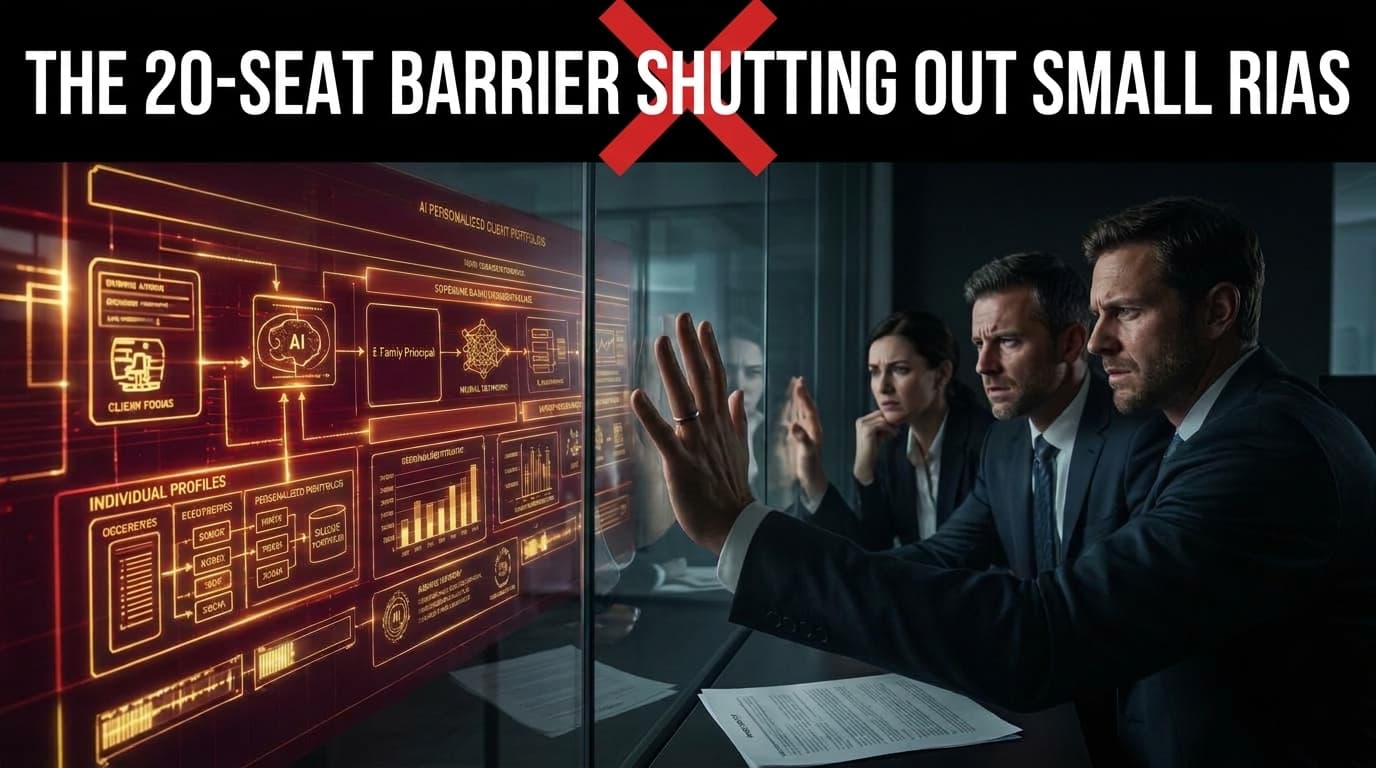
An AI announcement can reach thousands of advisory firms.
That does not mean thousands of firms can afford it, deploy it or use it to complete meaningful work.
Two recent RIABiz articles bring that distinction into focus:
- A reported 20-seat Enterprise minimum complicates adoption of Claude for smaller Schwab RIAs.
- Schwab's investment in Nevis supports a different proposition: an AI operating layer working across advisors' existing systems.1 2
My takeaway is not that one approach WINS and the other FAILS.
It is that wealth management needs to distinguish access to AI from the ability to operate with it.
Available does not necessarily mean accessible
RIABiz reports that Schwab promoted Claude for its approximately 16,000 RIA relationships, while Anthropic's Enterprise minimum creates a mismatch for many small practices.1
Anthropic's published Enterprise pricing lists:
- A 20-seat minimum.
- $20 per seat per month, billed annually.
- Usage charged separately.
That means a minimum annual seat commitment of $4,800 before usage charges and applicable taxes—not an all-in operating cost.3
For a firm needing three users, that is a different buying decision from a firm needing thirty.
An important qualification: Anthropic says its advisor plugin works on paid Claude plans, but recommends Enterprise for RIAs because of its audit logs and compliance controls. That is a vendor recommendation—not a regulatory rule requiring every RIA to buy Enterprise.4
The issue is therefore more nuanced than "small firms cannot use Claude."
The question is:
Can a small firm obtain the capabilities and oversight it needs at an economic scale that makes sense?
The more important gap: answers versus execution
The pricing debate attracts attention.
But the operational distinction matters just as much.
RIABiz quotes industry participants describing Schwab's connector as read-only and questioning how much work advisors can actually complete through it. That is a limitation of the reported integration—not proof that Claude, or every connected tool, is read-only.1
Read-only access can still be valuable:
- Reviewing portfolios.
- Preparing for meetings.
- Finding information.
- Drafting follow-ups.
But retrieving information and completing a workflow are different capabilities.
An AI-assisted workflow might also need to:
- Validate the information.
- Identify missing inputs.
- Route an exception.
- Request approval.
- Update an authorised record.
- Confirm that the update succeeded.
Connectivity enables access. Orchestration coordinates the work.
Build a unified data layer first
This was the most interesting argument in the Claude article.
Tim Welsh describes an approach in which firms integrate their systems beneath a shared data layer, then place AI above it. His argument is that this reduces dependence on individual systems and avoids repeatedly resolving incompatible data inside each AI interaction.1
I agree with the architectural direction—with one qualification:
A warehouse alone does not make information trustworthy.
The foundation also needs:
- Consistent household and account identifiers.
- Agreed ownership relationships.
- Shared definitions.
- Valuation dates and freshness indicators.
- Reconciliation and exception handling.
- Traceable sources.
Data infrastructure is the foundation because it establishes what the information means before AI tries to act on it.
Otherwise, an impressive model may spend each interaction trying to reconcile multiple disconnected systems—without a durable, approved resolution.
Where the AI Operating System story fits
RIABiz reports that Schwab is investing in and partnering with an AI Operating System startup, which positions itself as an AI operating system for financial advisors. The article describes an approach designed around existing advisory technology rather than wholesale replacement.2
That is relevant to firms assembled through acquisitions.
The challenge is not simply introducing AI. It is coordinating work across different applications, processes and data structures.
The promise of an operating layer is that a firm could retain useful systems while making workflows across them more coherent.
But positioning is not proof.
Investment, customer scale and funding do not establish that every workflow is reliable, autonomous or suitable for every RIA.
Nor should Schwab's investment be presented as a demonstrated response to the Claude pricing issue. The articles establish two developments—not that one caused the other.1 2
The more useful interpretation is that model access and workflow platforms can serve complementary purposes.
What "production-ready" should mean
An AI operating system should be judged by more than the number of applications it connects.
For me, production-ready AI workflows should demonstrate:
- Correct data: inputs are identified, checked and appropriately current.
- Consistent calculations: approved methods are tested and reproducible.
- Enforced permissions: access and actions are controlled behind the interface.
- Managed exceptions: missing information leads to a defined response.
- Verified execution: the system confirms whether an action succeeded.
- Accessible evidence: the firm can reconstruct what happened.
- Viable economics: total costs fit the firm's actual usage and capacity.
Read-only is not inherently bad. Write access is not inherently better. The goal is permitted, validated and accountable execution.
Five questions before the next AI purchase
Whether you run a small RIA, a family office or a larger advisory group, ask:
- What work can this complete today—not merely describe?
- How are conflicting records resolved across our systems?
- What requires human approval, and where is that enforced?
- What is the total cost, including minimums, usage, integration and oversight?
- Can we retain our data definitions and workflows if we change providers?
The market is moving beyond standalone assistants.
But an "AI operating system" should earn that label through operational results—not branding.
A chatbot that answers questions can save time.
A platform that reliably carries work across existing systems could change how an advisory firm operates.
The difference is not simply a better model. It is the infrastructure, controls and economics that turn AI availability into work completed.
Sources
- Schwab trumpeted Anthropic's Claude for all 16,000 of its RIAs, but a 20-seat Enterprise minimum suddenly sidelines 11,000-plus small firms right before Impact 2026
- Schwab is the latest to leap on runaway Nevis AI bandwagon with capital backing and a critical endorsement
- Claude Enterprise Pricing
- Claude for Financial Advisors